

The Heatwave That Broke Memory
Europe was built for a climate that no longer exists



The north is supposed to be the escape route in the European imagination. The place with snow in the bones of the houses. The place that proves summer still has limits. The place you mention when someone complains about heat in London, Paris or Madrid and you want to remind them that another Europe does exist.
Then the heat arrives here too.
So when I hear people in Britain reaching for 1976 as proof that everyone has become weak, I hear more than bad history. I hear a continent trying to cool itself with nostalgia.
We had summers like this before. People got on with it. Schools stayed open. Nobody panicked. The country did not melt because the sun came out.
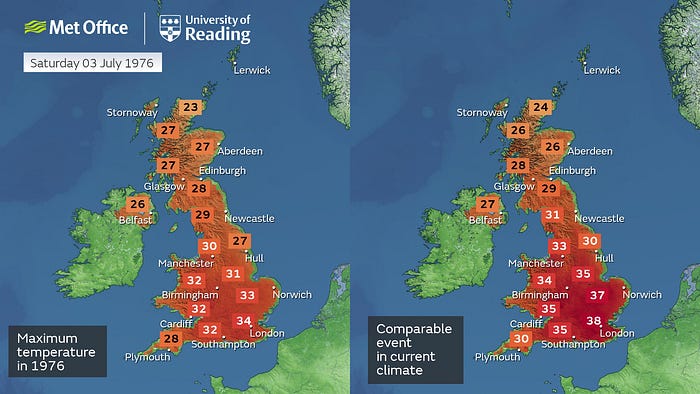
The line has the rhythm of a newspaper column written under an AC set at 17°C. It carries a real memory and then abuses it. Those who were there say the summer of 1976 was brutal. Britain had drought, crop damage, water restrictions, dry rivers, standpipes in streets and weeks of heat that entered national mythology. For many people, it was a very serious event.
That is exactly why the comparison matters.
The problem is that some manipulative people are holding up an old heatwave as proof that nothing new is happening, as if the atmosphere had stayed still for fifty years because a few people remember drinking warm squash and walking to school. Memory is being used as air conditioning.
This June heat has entered the body.
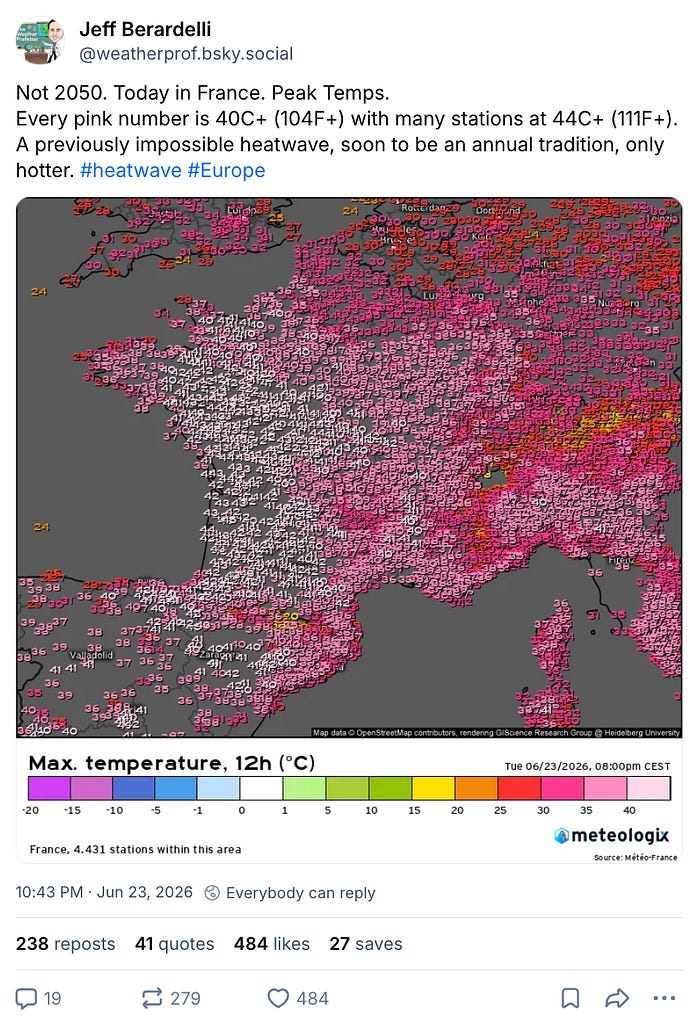
Across Europe, records have fallen in the UK, France, Germany, Czechia, Poland, Switzerland and elsewhere. France reported around 1,000 excess deaths during the worst stretch. The World Health Organization’s director-general said more than 1,300 excess deaths had been recorded across Europe since June 21, with more than 150 million people affected by extreme heat — and extended impacts on ecosystems, agriculture, infrastructure and labour productivity, along with worsening drought and wildfire risk in some areas.
That is a continent discovering that old comparisons can become dangerous when the climate changes faster than the story people tell about it.

A multi-day physiological debt
The UK Met Office and the University of Reading ran the obvious question: what would a 1976-style heatwave look like in today’s climate? Well, a comparable event would already be around 3°C hotter today. By the 2050s, under a high-warming pathway, a similar event could push parts of the UK toward 45°C.
So there you are, on an old top-floor flat in a European city: tin roof, big windows, no external shutters — the kind of place that might get “a bit stuffy” for a week or two and then reset at night.
In the 1976 version of the same heatwave, the hottest afternoon might push the living room to ~29–30°C. Unpleasant, but survivable with the usual improvisations: curtains half-drawn, a fan, a cold shower, maybe, yes, sleeping on the floor. Crucially, night gives you the refund: by 3 a.m., the room might finally slide down to ~21–22°C. You don’t sleep great, but your body gets a break. The next day starts with a little margin.
Now, what would a 1976-style heatwave look like in today’s climate? Well, a comparable event would already be around 3°C hotter today. Same weather pattern, same sunshine, same stubborn high pressure — just a warmer baseline.
That ‘29–30°C inside’ becomes 32–33°C inside. The same room, but now the air feels like it has weight. The fan starts feeling like a hairdryer. The kitchen becomes a choice: eat something cold, or cook and pay for it with another degree you can’t afford. Add it to a fever. Add it to an attic. Add it to a train carriage without air conditioning. Add it to a hospital cooling unit already failing. Add it to a body whose heart is trying to move heat toward skin that has nowhere cooler to send it.
And the real shift happens after dark. In the old version, the night was when your body cashed in its survival check. In the +3°C version, the night stops being recovery and becomes continuation. Instead of the room slowly falling to 21–22°C, it stalls at 24–25°C, sometimes higher, warm enough that sweat doesn’t evaporate properly, warm enough that sheets feel damp and “rest” becomes a series of short, shallow, sweaty naps.
Day 1: You’re uncomfortable. You cope.
Night 1: You don’t reset.
Day 2: You begin already depleted — headachey, irritable, a little nauseous, clumsier than usual.
Night 2: Your heart keeps working like it’s still daytime.
Day 3: The heat becomes less like weather and more like a low-grade illness that won’t lift.
That’s what climate change does to a heatwave: it turns a bad afternoon into a multi-day physiological debt, mostly by taking away the part people forget to mention when they brag about the past: the cool night that made the past survivable.
World Weather Attribution looked at the June 2026 event and found that, over the studied region, it was the most severe ever recorded. In the climate of 1976, the 2026 temperatures would have been virtually impossible in June and highly unlikely even at any point in the year.
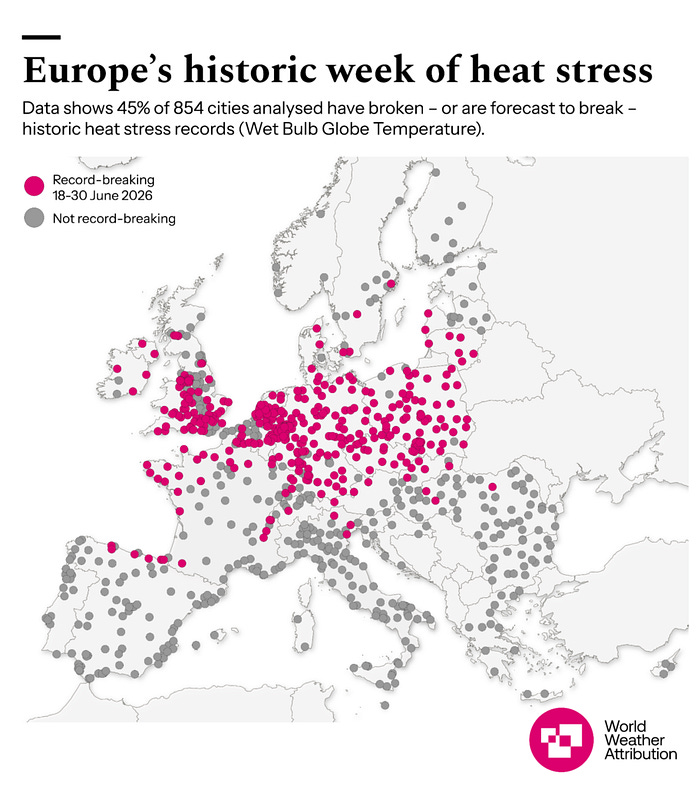
The same atmospheric circulation would have produced a heatwave about 3.5°C cooler during the day and 2.4°C cooler at night in 1976. Compared with 2003, the daytime heat is now about ten times more likely, while the nighttime heat is more than one hundred times more likely.
The old reference point has certainly expired.
The cooking lid
A heatwave sounds like movement: a wave that should pass. But this one behaved more like a lid.
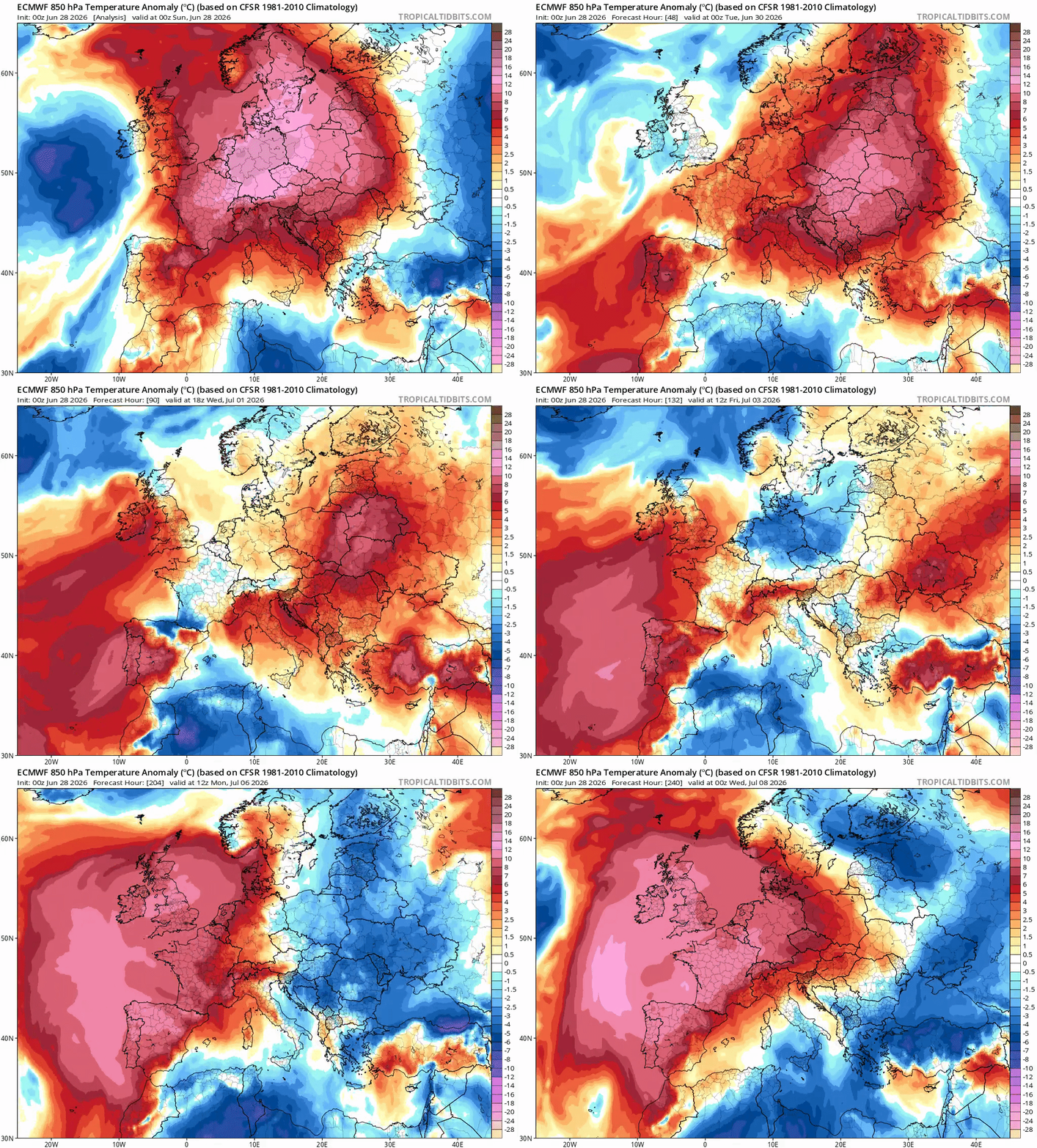
A strong area of high pressure built over continental Europe. Under high pressure, air sinks. As it sinks, it warms. Clouds are suppressed. Sunlight keeps landing. The normal movement of weather slows. Hot air from lower latitudes is pulled north and held in place. And so, temperatures rose well beyond seasonal norms across central and western Europe, in many cases around 10°C above average for mid-June.
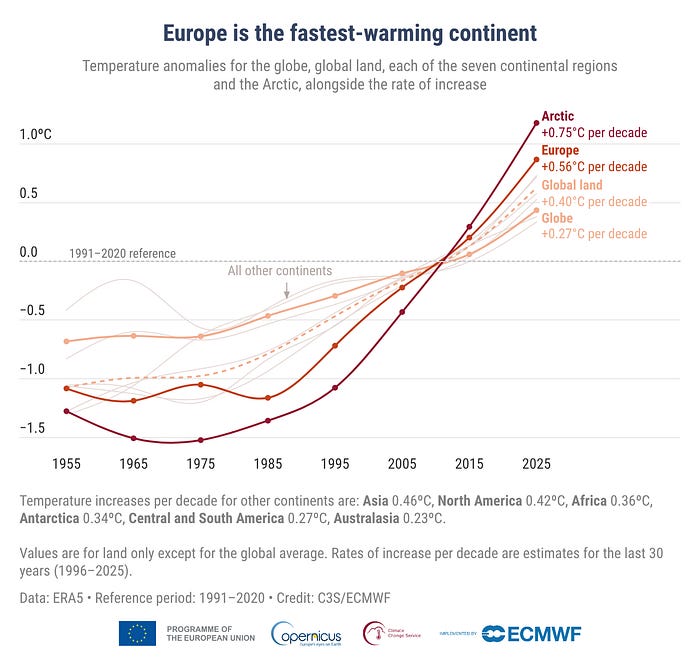
But a high-pressure system over Europe in 1976 landed on a cooler continent. A high-pressure system over Europe in 2026 lands on cities, roads, rivers, hospitals, schools and apartment blocks already living inside a warmer climate. Europe has warmed faster than any other continent, and WMO says Europe as a whole has warmed by about 2°C since the 1976 heatwave.
And it is the number plus humidity. The number plus a nurse, a delivery rider, a construction worker, a farmer, a cleaner, a care-home resident, a patient waiting for a scan. The number plus a night that does not cool down.
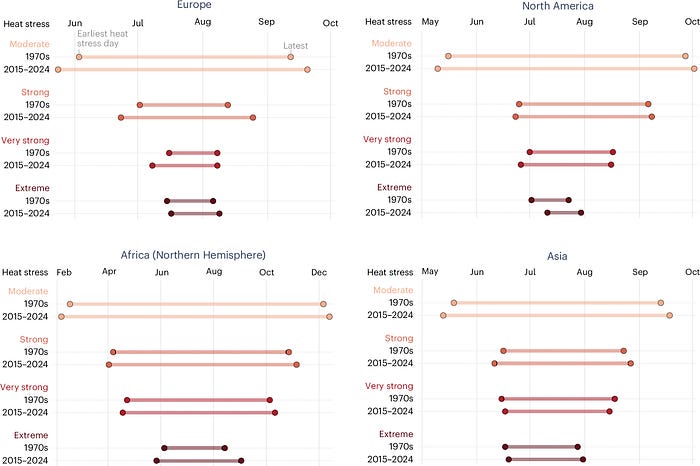
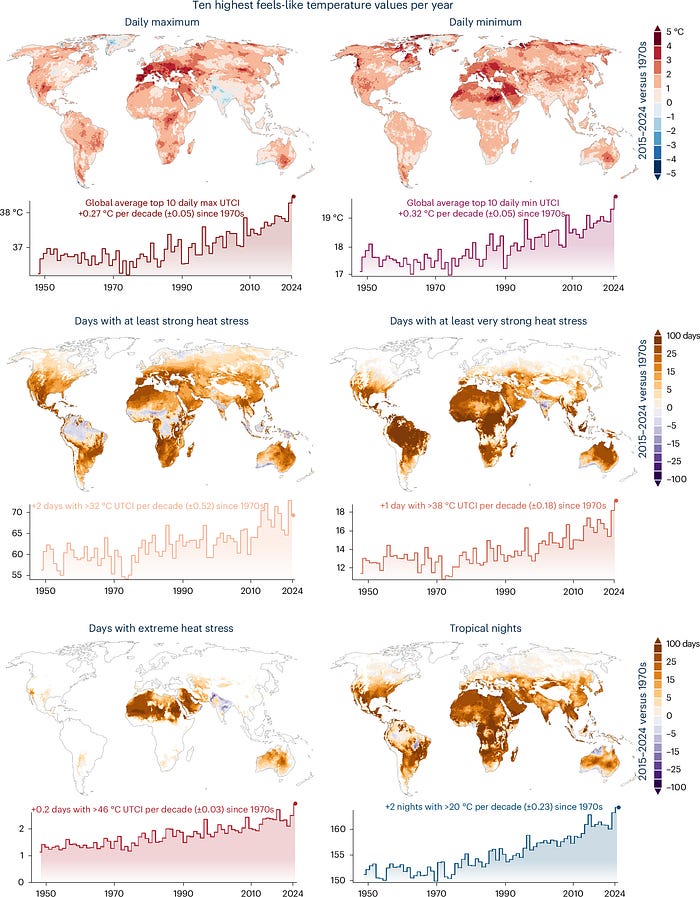
The newest global heat-stress research makes that failure harder to ignore. A recent study found that extreme “feels-like” heat is increasing on every continent, hazardous heat is expanding into places that used to avoid it, and the hottest nights of the year are warming faster than the hottest days. Exposure to at least one day of extreme heat stress has risen from 16% of the global population in the 1970s to 22% today: roughly one billion more people.
Heat kills through accumulation. The body can fight for a while. It can sweat, pump harder, redirect blood, and slow down. At some point, the body needs relief. But when the room stays hot, the body keeps paying.
Extreme heat is a sorter
Heat separates those with shade, cooling, flexible work and good housing from those expected to survive the same temperature with fewer tools. It also punishes age, illness and isolation. The World Health Organization describes heat stress as a major environmental and occupational health hazard that can worsen cardiovascular disease, diabetes, mental health conditions, asthma and the risk of accidents, and it notes that extended high day and nighttime temperatures create cumulative stress on the body.
That is the medical version.
But you can see it in a person who stops cooking because the stove would make the room worse. A child that becomes irritable because the body is tired from cooling itself. A worker who gets clumsy. An older neighbour who stops answering messages. A commuter who steps into a train and feels the air become a wall.

So the person saying “we had hot summers before” is rarely the person in the hottest room, on the longest workday, with the weakest heart, the least money, the smallest margin, or the least control over the day.
Europe already knows what follows. The summer of 2022 produced an estimated 61,672 heat-related deaths across Europe, according to a study that examined mortality across 35 countries and more than 500 million people. The following year, another study estimated 47,690 heat-related deaths in 2023, despite adaptation efforts that likely prevented an even larger toll.
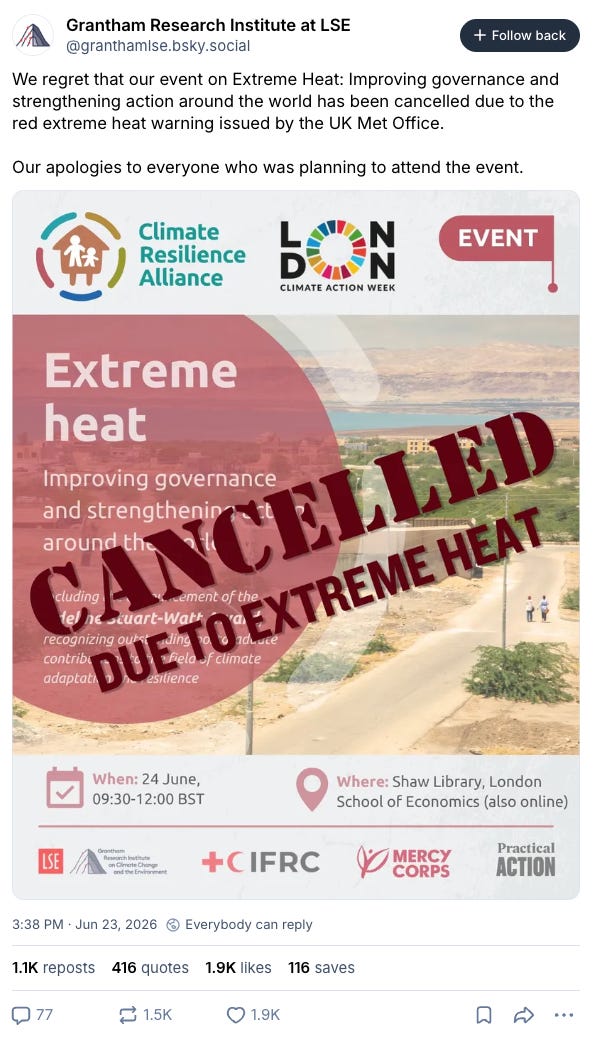
The UK Met Office issued a Red Warning for Extreme Heat for three consecutive days, the first time the current warning system has done that for heat. And call it irony: in London, extreme heat forced the cancellation of an event about…extreme heat.
Built for a different climate
Apartments designed to hold warmth become ovens. Zinc roofs in Paris store the sun and return it to the rooms below. London Underground lines without full air conditioning become hot tunnels full of bodies. Hospitals lose cooling capacity. MRI machines, IT systems and radiotherapy equipment struggle. Schools close or shorten hours. Outdoor work moves toward dawn. Water demand rises. Electricity demand rises. Rivers warm or fall, critical for power stations that need water for cooling. Trains slow because metal expands. Asphalt gives back the day at night.
A city becomes less modern very quickly when the indoor temperature rises beyond what the building can handle.
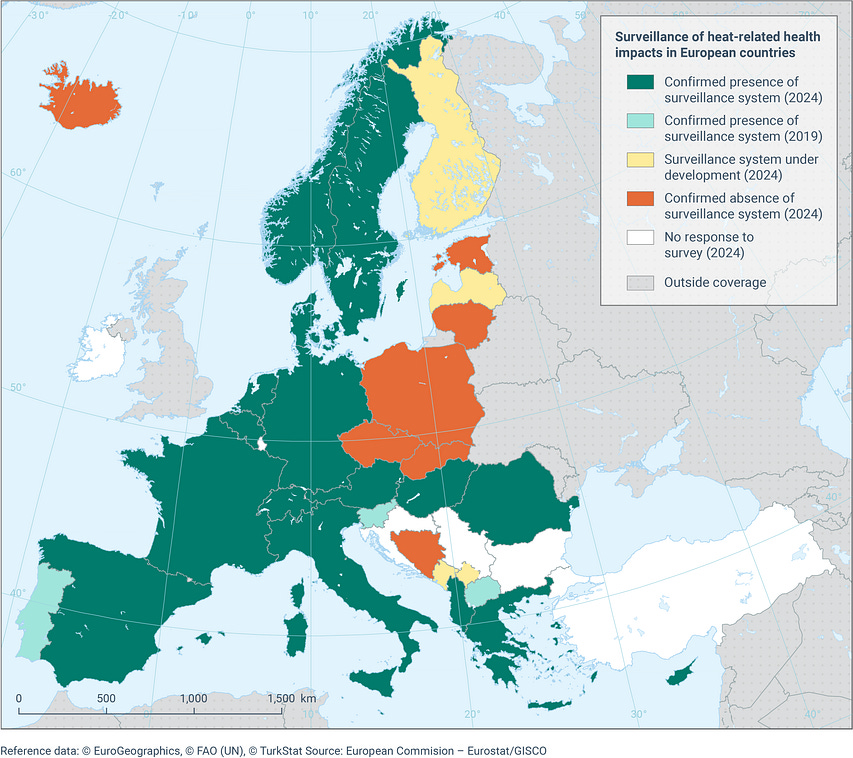
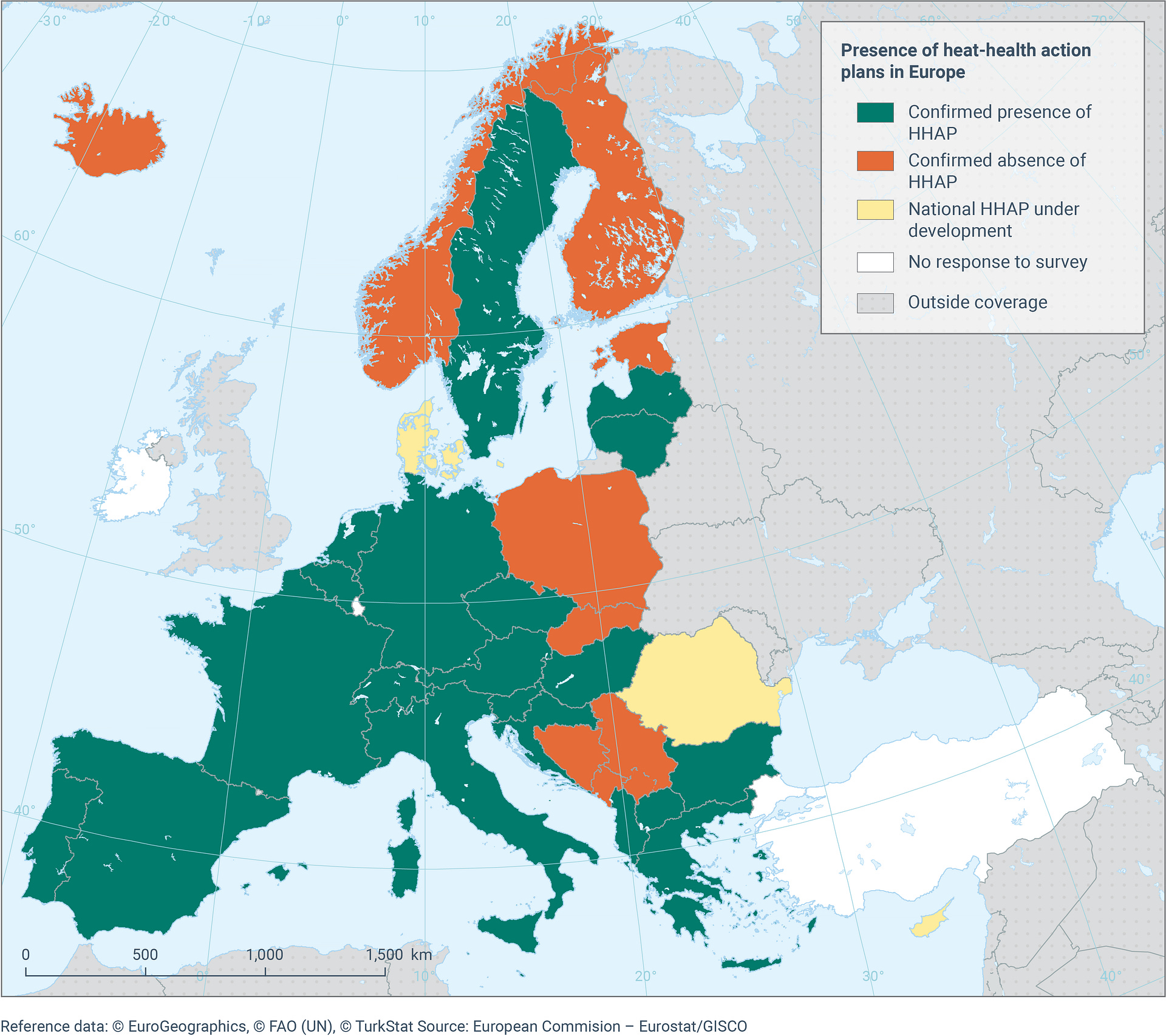
The European Environment Agency has warned that heat-health preparedness across Europe still has severe gaps, even as heat risk increases and surveillance, action plans and targeted protection become more important. The heat is arriving faster than the retrofit. This is why air conditioning has become politically charged. It is both relief and trap. It can save a life in a room right now. If powered by a fossil-heavy grid and used as the central answer, it adds demand to a system already strained by the same heat.
The point is not to shame people for wanting to cool a bedroom. The point is to shame leaders who turn private cooling into a substitute for public adaptation and fossil fuel phaseout.

Shade is infrastructure. Insulation is infrastructure. Tree canopy is infrastructure. Cool roofs are infrastructure. Worker protections are infrastructure. Heat-health systems are infrastructure. Cleaner electricity is infrastructure.
The future is not impressed by speeches about resilience if the apartment still reaches 34°C at midnight.
M.
 | A guest post by
|
YES YES YES YES and YES. As usual, you've encapsulated things perfectly. Thank you!
Now I should probably apologize up front for a rant, but... will you allow me to vent briefly? I am soooooooo danged sick of the Heat Olympics right now. You know the kind of thing... "wow, I live in Tucson and we regularly have highs of over 105! We just use evaporative cooling and no worries - we get through it just fine!" And also... "not sure how you can complain from London when tens of thousands of folks in India die from the heat annually... feels a lot like your privilege coming out, no?"
IT IS HOT. It is also, depending on where you are, rainy, flood-y, drought-y, wildfire-y, and sea level rise-y. This is a global emergency. There is plenty of suffering to go around, without people devolving into sniping over who has it worse and who isn't prepared and who has the right to actually complain.
Right now we should all be coming together to HELP EACH OTHER. Not argue about why Europeans "don't really have it bad." FFS. Gah!
Thanks for listening.
The Icelandic Low is likely going to be pushed further south and hit the UK, possibly leaving Norway alone. Depending on jet streams and the Cold Blob off Greenland. They may stop complaining about rain all together and put the attention to clothes and infrastructure like people in Bergen with 199 rain days per year, continuous rain without stop being more than 90 from November to February. It's mild weather being low pressure with additional ocean heating by Norwegian standards.