

The Energy Lockdown Has Started
The war in Iran didn’t just block a shipping lane. It started dismantling the infrastructure the world runs on.


The initial expectation, in the first days after the Strait of Hormuz closed, was that the disruption would last a week, maybe two. Markets would tighten, prices would spike, diplomats would find an off-ramp, and the global energy system would resume its ordinary, polluting hum.
That expectation has now imploded, and how fast it did only reveals something that should be obvious, yet until this war we barely thought about: we have badly underestimated how dependent modern life is on the fossil-fueled energy system we built.

If you would like to contribute to the project, this is the place to do so!
The world’s largest LNG plant in Qatar sustained damage from a drone attack more than two weeks ago. Qatari energy minister Saad al-Kaabi said afterward that returning to full production would take “weeks or months.” That was before Israel bombed the South Pars gasfield, which Iran shares with Qatar, and Trump denied that the US knew about the plan (Israeli sources say that the US helped to coordinate the attack). Before Iran retaliated by striking energy facilities across Saudi Arabia, the UAE, Kuwait, and Bahrain. Before Qatar Energy warned that damage to its Ras Laffan facility, the plant that normally supplies a fifth of the world’s liquified natural gas, could take three to five years to fully repair, and that it might have to excuse itself from long-term contract obligations to Italy, Belgium, South Korea, and China. Before Iranian Foreign Minister Abbas Araghchi warned publicly that Iran would show “zero restraint” if its infrastructure was struck again.
Then Iran struck the Haifa oil refinery, Israel’s largest, and burned it to the ground. The country that started this war is now running its war machinery on borrowed fuel, scraping reserves it did not expect to need, discovering that the infrastructure of military power and the infrastructure of energy are, in the end, the same infrastructure. The machine that launches the strikes depends on the same supply chains it is destroying.
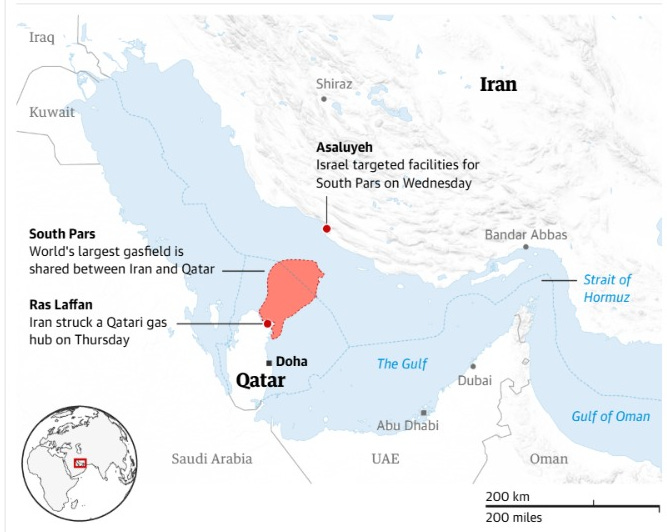
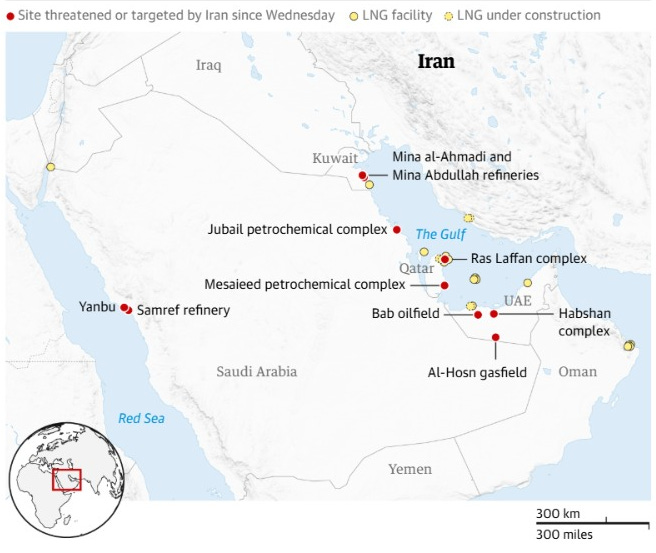
(Source: The Guardian)
The conflict has shifted from blocking trade flows to destroying the infrastructure that makes those flows possible. These are not the same kind of problem. A blocked shipping lane reopens when the politics change. A damaged gasfield does not restart because someone signs a ceasefire. Compressors, pipelines, liquefaction trains, offshore platforms: these are not valves you turn back on. They are industrial systems that take years to build, require specialized equipment and engineers to repair, and fail on timelines that have nothing to do with diplomatic calendars.
Disruption horizons have been morphing from days to weeks to months to years. The world needs to prepare for an extended energy shock, and it needs to start now.
And then there is the damage that no diplomatic calendar will ever repair. Because if the first casualty of war is the truth, the environment follows close behind.
Two weekends ago, black rain fell on Tehran. A toxic sludge of soot, smoke, oil particles, and sulfur compounds, the direct product of strikes on oil storage facilities, descended on a city of ten million people. Residents described the air as “apocalyptic”, reporting burning in their eyes and throats and difficulty breathing — the sensation of a sky turned into a living hell. The compounds released carry elevated risks of cancer, cardiovascular damage, and long-term respiratory disease. If those pollutants reach the already scarce water sources, aquatic life and drinking supplies follow. The region sits on an ecological knife-edge, with barely protected oil and gas facilities ringing the Gulf, within range of everyone’s missiles.

The first twelve months of Russia’s invasion of Ukraine emitted 120 million tons of carbon dioxide into the atmosphere, roughly one-eighth of global aviation’s annual output. The war in the Gulf is adding its own massive load to an atmosphere already running at an accelerated warming rate. Every strike on an oil depot, every burning platform, every pipeline rupture is a disproportionate carbon event that does not show up in any country’s official emissions accounting, because wars are exempt from the frameworks designed to measure the damage civilization is doing to itself.
What we are seeing now are the highest-visibility, highest-impact attacks on innocent lives, key energy systems and the environment, which together will add up to a toxic, mourning legacy that will blight the whole region and the world (but especially Iran) for decades to come.
Energy shocks don’t end with a ceasefire. Once you start burning the refineries, you are rewriting the climate, the health baseline, and the future.

Lessons and Measures of Convenience
The most recent template for an extended energy shock is Europe after Russia’s invasion of Ukraine in 2022. The response had four components: replace, restock, protect, and cap. Each one worked in the narrow sense of preventing immediate collapse. Each one also produced consequences that the architects of the policy preferred not to advertise.
Replacing Russian gas meant scouring the world for alternative supply, primarily American LNG shipped across the Atlantic. It worked. But the scramble among countries for a finite global pool of supply pushed prices upward everywhere. Poorer countries, unable to compete at the prices European buyers were willing to pay, were priced out entirely. Bangladesh endured blackouts. Sri Lanka went into economic crisis. The grain from Ukraine that should have gone to Somalia went to Germany instead, all because Germany could pay more.
Restocking meant filling European gas storage over the summer, under government mandates to utilities to hit targets by autumn at any cost. The signal that reached traders was simple: name your price — and prices rose accordingly.
Protecting consumers meant subsidies on a scale that European governments had not deployed outside wartime. The European Commission estimates that total energy subsidies across the EU jumped from €213 billion in 2021 to €397 billion in 2022, and barely fell in 2023. The subsidies kept households warm and politically stable. They also kept consumption higher than it would otherwise have been, which kept wholesale prices elevated for longer.
Capping prices on traded gas exchanges was supposed to put a ceiling on the damage. But a cap set below global market prices simply meant that scarce LNG flows went elsewhere, to buyers willing to pay the market rate. The cap was eventually made flexible, which is another way of saying it was not really a cap.
The piece that was never seriously tried was demand reduction. And now it is arriving anyway, through a different door, under a different name, with the same instructions attached.
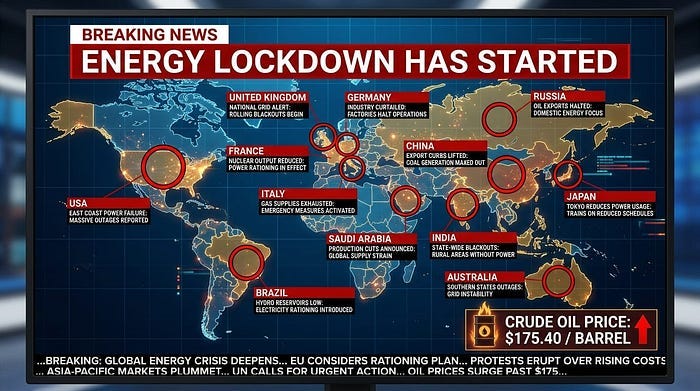
After the largest release of government oil reserves in its history to help calm the oil price shock, the IEA provided 10 measures to shelter from oil shocks by reducing demand and helping households and businesses prepare for a drawn-out disruption to energy markets. These included: work from home where possible, reduce highway speeds, restrict car access in major cities through number-plate rotation, limit air travel, encourage public transport, and shift industrial feedstocks.
Japan is already rationing fuel. South Korea is rationing fuel. Bangladesh, the Philippines, and Sri Lanka are rationing fuel. Fuel siphoning from cars has begun in Australia.

You heard it in 2020. They called it a health measure then. They are calling it an energy measure now. The wording is identical. The mechanism is identical.
The concept of the individual carbon footprint was popularized by a BP advertising campaign in the early 2000s. The logic was elegant then and it is being recycled, once again, in the name of Big Oil: we are in a rough patch, but we’ll eventually make a comeback. So hang tight: we will never leave you alone — it’s too profitable for us. If the crisis is caused by your choices, the solution is your choices, and the structural question of who built the system that produced those choices disappears from view.
Sure, we all individuals should do our best to live more environmentally friendly, to consume consciously, and understand when enough is enough. But the Ras Laffan facility wasn’t damaged because you forgot to turn off your heating. The Strait of Hormuz did not close because you were driving fast on the highway. It is this predatory system, the one that has turned us all into fossil fuel slaves, the same system that is now asking you to solve it by driving less, flying less, and working from home.
The infrastructure burning across the Persian Gulf was built by governments and corporations over seventy years, organized around a resource they knew would produce exactly this kind of crisis, maintained with military force and decades of deliberate public misdirection. And the response, when the crisis arrives on schedule, is a list of ten things you personally should do differently.
You did not choose fossil fuel dependence the way you choose a subscription. It was built into the infrastructure of the life you were born into, before you had any view on the matter, by interests that have spent the decades since ensuring the alternatives remained expensive, marginal, and politically inconvenient.
Yet by now, even the most die-hard pro-fossil-fuels climate change deniers see that this energy shock that is coming for all of us wouldn’t have happened at this scale if the transition to renewables were a reality and not just an addition to a system of endless extraction and consumption.
What is happening is this: oil is heading toward $150 per barrel and possibly beyond. Airlines are already cutting routes. United Airlines cut 5% of its capacity this week, and its CEO is planning for $175 oil through the end of 2027. Trucking costs are rising, which means every product in every store costs more before it reaches the shelf. Fertilizer stopped moving through the Strait of Hormuz weeks ago, which means the harvest planted this spring will be thinner than it should be, which means food prices will climb through the autumn and into next year. Gasoline is already at prices that are changing behavior even in conservative countries.
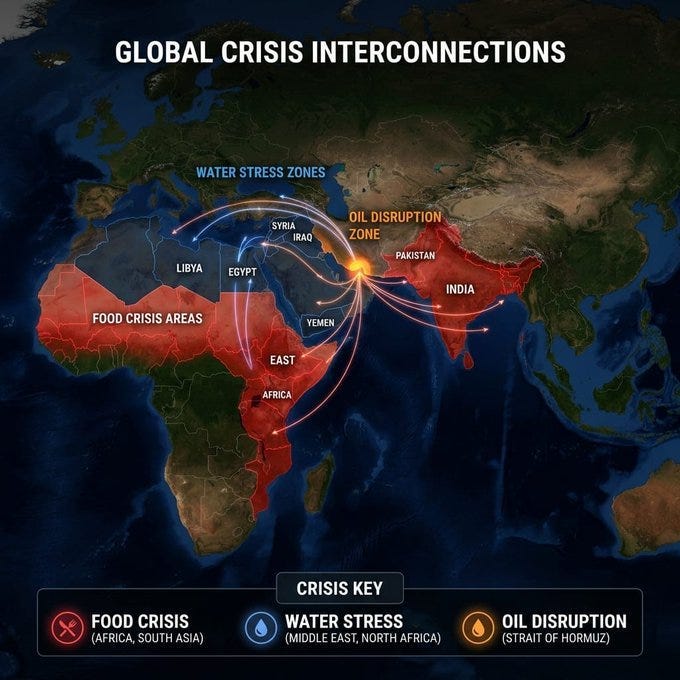
The COVID parallel is not incidental. In both cases, a systemic failure, one of public health infrastructure, one of energy infrastructure, was reframed as a behavioral problem requiring individual compliance. In both cases, the people who built the conditions that made the crisis possible retained their power, their profits, and their ability to define the terms of the response.
In both cases, the language of collective sacrifice was deployed to protect arrangements that serve a concentrated minority at the expense of everyone else.
How We Got Here
The intense and sustained Western interest in the Middle East is not a random political tic. By now, we all know what is hiding beneath the ground. Yet it all started in 1953, when Winston Churchill’s government persuaded the CIA to launch a coup against the democratically elected government of Mohammad Mossadegh, who saught to nationalize the Anglo-Iranian Oil Company, so they wouldn’t be stolen by an imperialistic foreign country. The coup eventually succeeded, and in 1954, the Anglo-Iranian Oil Company was renamed British Petroleum, now BP, and one of the most polluting companies on Earth.
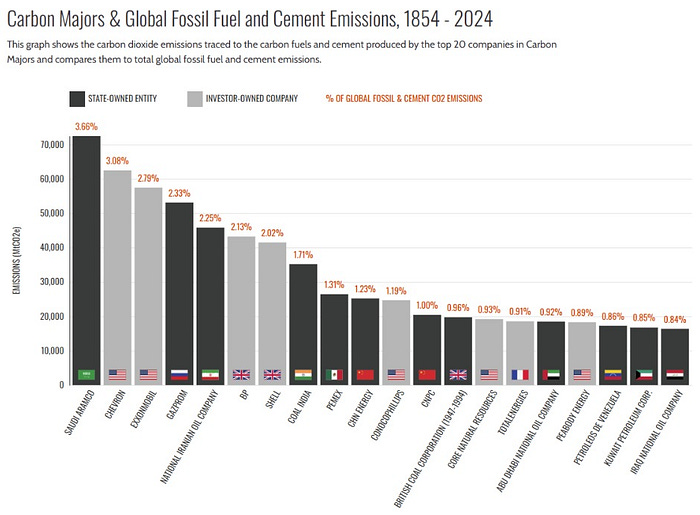
The US and Britain helped topple Iran’s elected government to protect oil interests. That opened the door to decades of dictatorship under the shah, which eventually sparked the 1979 revolution. The ayatollahs then seized control of that revolution, and Iran has lived with the consequences ever since. So today’s conflict is not some random eruption. It traces back to that earlier decision to crush a democracy because it tried to control its own resources.
This is what gets hidden when people say “free-market capitalism.” The system that controls the world’s energy is not “free” in any ordinary sense. It runs on taking resources, using force and covert power to punish countries that push back, funneling money from poorer places to rich financial centers, and dumping the real costs onto the public, the environment, and the people who rely on it.
Land, water, oil: in many cases, they are simply taken. Public resources are handed to private monopolists. The powerful are bailed out when they fail. The rest are told that the market has spoken.
Military power exists in large part to keep this system running. And it is not just weapons: lobbyists, friendly media, and social media algorithms that reward outrage and division do the same job. They help keep the most oil-friendly leaders in charge, and they make people pushing for change sound naïve, unpopular, or “too expensive.”
During the worst of Covid, surveys consistently showed that most people wanted the reset to stick: a world that put health, quality of life, and environmental protection ahead of nonstop economic growth. Instead, governments spent billions trying to get everything back to “normal,” including the parts that were already broken.

Prepare For The Shock
The additional cost of a single fossil-fuel price spike on the scale of 2022 equals the entire cost of achieving net zero by 2050. The Iran shock will cost more than 2022. In return for an oil price spike, you receive nothing except damage and a bill. In return for the transition, you receive an energy system with no Strait of Hormuz, no gasfield a drone can take offline for five years, no cartel that can triple your heating bill on a Tuesday because a war started somewhere you cannot find on a map.
Iran has the capability to strike Israel’s nuclear facility at Dimona. The day that happens is the day this crisis leaves the category of recoverable catastrophe and enters the category of permanent rupture. A conventional war over infrastructure has a reconstruction timeline. A nuclear exchange has a before and after, and no government currently fighting this war has explained publicly what their plan is for the moment those two categories collapse into each other.
Here is what connects the war, the price spike, the climate breakdown, and the democratic recession into a single system rather than a series of separate bad events. As renewable energy began genuinely threatening hydrocarbon revenues, the political response was immediate and coordinated: new laws criminalizing climate protest, earth defenders shot by paramilitaries in the global south, billions redirected into denial infrastructure and the capture of political systems that might otherwise regulate them.
If you would like to contribute to the project, this is the place to do so!
Fossil power does not just fuel economies. It fuels the political arrangements that protect fossil power. The loop is self-sealing, and it has been tightening for thirty years.
Break the fuel dependency, and the loop breaks with it. Without oil revenue to protect, there is less reason to run the coups, the assassinations, the wars, the kidnappings and the autocrats kept in power because they keep the supply moving. Without the chokepoint, there is no chokepoint to fight over. Without the extraction economy demanding political cover, the political cover becomes harder to sustain.
A transition to renewables is a threat to the entire architecture of concentrated power that the fossil fuel economy has built and maintains. That is why the transition has been delayed for fifty years by the people with the most to lose from it.
Prepare for the shock.
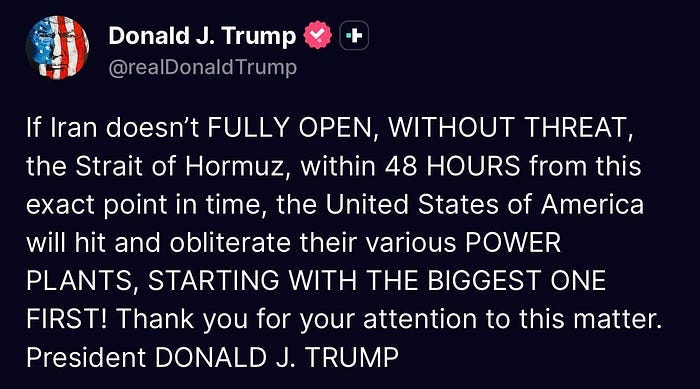
You can do what the governments are asking: drive less, fly less, turn down the thermostat. But know that all of it helps, but mostly at the edges. So hold this alongside it: the energy shock, the political crisis, and the environmental crisis are the same problem. And the real fix is not just personal sacrifice. It is an emergency push to get fossil fuels out of everyday life, faster and further than any government is currently planning.
That is the only path to breaking the oligarchy that keeps this system in place.
May the northern lights guide you,
M.
 | A guest post by
|
Good post. It's hard to say what the ultimate fallout of this war is going to be, but it will be significant. It marks a new chapter in collapse. I read there could be an additional 45 million people at risk of starvation in the next year alone.
The forced austerity of this war will likely reduce oil demand which is currently flat. This will extend the life of this deadly resource, but it all depends on EROI. The most expert I read in the industry can't put an exact date on when pumping oil will be economically unviable, but I believe the window to be 30 to 50 years.
The 8 billion of us on the planet were made possible by oil. A horrifying population crash is inevitable. This WILL be a low energy world one way or another. Without diesel there can be no electrification of the economy. It's remarkable how few see this obvious Catch-22.
israel and Donald Trump attacking Iran has caused a new time line to start. The new time line CHANGES EVERY THING for the worse. This new time line is very bad for the world. NO food, no water, no electricity, no gas, etc.
Short: NASA warns of potential blackouts across Earth: https://www.youtube.com/shorts/XYqwWulwZ54 .18 seconds
The video below is very important, please watch it. Digital IDs may be used to ration the food and gasoline. Shortages on food and medicines are coming to America in a few weeks.
👉 Two Weeks to Flatten the Fuel Curve: Digital IDs, Rationing, Energy Austerity https://unshadowed.substack.com/p/two-weeks-to-flatten-the-fuel-curve 👀 WATCH